EXPEDITION EXTREME: XXL ADVENTURE THROUGH THE ICE WORLD OF DENALI
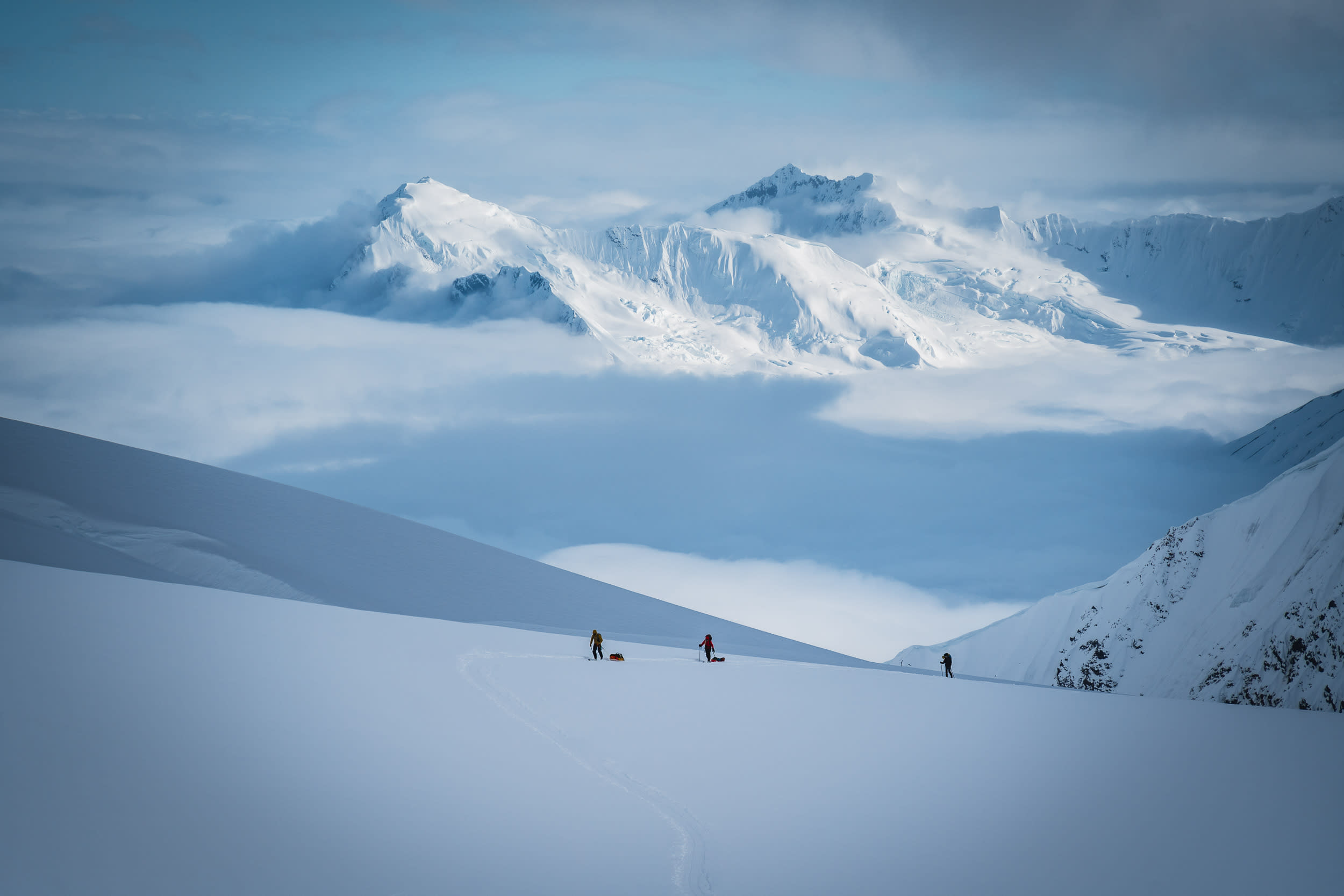
Ten days in temperatures with wind chills reaching minus 40 degrees. Wind gusts exceeding 80 km/h. We are a team of six, carrying only the essentials, with 84 kilometres of ice and snow-covered terrain ahead of us. At 6,190 metres, Denali is the highest peak in North America – and arguably the most underestimated of the Seven Summits. Size doesn’t matter. This extreme expedition is the ultimate real-world test for the VAN DEER-Red Bull Sports Touring Series. To us, Denali is an eight-thousander, even if it technically isn’t: by the end of the journey, we will have climbed 8,562 vertical metres and skied down a similar distance. The story of an XXL ski tour.
As the plane takes off from the Kahiltna Glacier and the sound of its engine disappears into the distance, all that remains is the endless frozen wilderness – and the six of us in the middle of it. Unsupported. For us, that means no guides, no porters, no supplemental oxygen, and no resupplies.
I’m Sabrina Krammer, and together with Sebastian Scheichl, I am a Touring Ambassador for VAN DEER–Red Bull Sports. The expedition team also includes Tom Czermak, Thomas Herdieckerhoff, David Schuchter and Schuyler Jorgensen. Planning, camp construction, cooking, equipment logistics, acclimatization, and every weather and safety decision – everything on this expedition is our responsibility alone.
From this point on, we have only ourselves. And 350 kilograms of expedition gear. Compared to the approximately 1.4 tonnes of supplies and equipment that the first ascent team transported to the mountain by dog sled in 1913, it may not sound like much. But carrying up to 55 kilograms of additional weight on top of our own body weight through this frozen world of ice and snow is anything but easy.


Why Denali?
At 6,190 metres, Denali is not an 8,000-metre peak. And yet, it is one of the most demanding of the Seven Summits. Because altitude is relative: the mountain lies at around 63 degrees north latitude, close to the Arctic Circle. Due to its northern location, the physiological effects of altitude are significantly more demanding. Between base camp (at around 2,200 metres) and the summit, there are almost 4,000 metres of elevation gain. But with equipment carries, establishing caches, and acclimatization rotations, we will cover many sections multiple times – meaning that by the end of the expedition, we will have effectively climbed the equivalent of an eight-thousander.
Denali is neither a fashionable peak nor a mountain built for the masses: vast glaciers, dangerous crevasse fields, dramatic weather changes, whiteouts, storms, and its relentless remoteness define this mountain. A peak with history. In 1972, Swiss extreme skier Sylvain Saudan, the “Skier of the Impossible”, became the first to ski the steep couloir that now bears Messner’s name. In 1976, Reinhold Messner and Austrian high-altitude physician Oswald Oelz completed the first ascent of the Direttissima route.
Five decades later, we are choosing a different route and a different style of expedition. For us, the attraction is not only reaching the highest point in North America – it is also the once-in-a-lifetime ski descent that awaits us there.
Into the Frozen Wilderness
May 28, 2026. This final evening flight from Talkeetna to Denali Base Camp will stay with all of us as the most beautiful flight of our lives. Below us stretch the endless glaciers and towering ice walls of the Alaska Range – breathtaking, a glimpse of a pristine and untouched world. From above, we realise just how small we truly are. Even more so when the six of us are left completely on our own in this vast wilderness, beginning our ascent towards Camp 1. Shortly before midnight, our first camp is established. As soon as the sun disappears behind the peaks, temperatures drop dramatically. Everything outside our sleeping bags freezes within minutes.
The following day, we begin our first rotation, climbing directly from Camp 1 to Camp 3 at around 3,400 metres. Climb up, cache equipment, ski back down, sleep lower: following this rhythm, we gradually make our way higher while slowly acclimatising our bodies to the altitude. A total of 350 kilograms of expedition gear – tents, food, fuel, safety equipment, personal gear, skis and spare parts – has to be moved up the mountain. During the most demanding stages, each of us carries 25 to 30 kilograms on our backs while pulling another 20 to 25 kilograms in a sled. Up to 55 kilograms of load per person – more than two full bags of cement that each of us drags uphill. The dream of Denali is a heavy one. Skiing with a heavy load is learning by doing. On traverses, the sled pulls downhill; during direction changes, it tips sideways; in uneven snow, it hangs from the harness and fights every movement. With a few creative manoeuvres, we quickly develop a technique that works.
We are using the VAN DEER–Red Bull Sports TOUR 75 and TOUR 85 models. The ultimate real-world test. On Denali, a ski needs to have it all: light enough for almost 4,000 metres of ascent, yet stable, smooth and precise enough to handle constantly changing conditions – from blue ice and wind-packed snow to breakable crust and powder – all while carrying heavy packs and skiing on tired legs. The edges need to provide grip on ice; bindings, skins and ski crampons must withstand extreme cold and icing. Here, a gear failure is not just an inconvenience – it can put both the expedition and our safety at risk.
Windy Corner: A Stormy Passage
From Camp 3, the route continues towards Camp 4 at 4,300 metres. It is only day five – significantly earlier than planned. After a stormy rest day, a new weather window opens, and we feel ready to tackle the first key sections of the climb: steeper slopes, icy traverses, and passages such as Squirrel Hill and Windy Corner. The latter is named for a reason – it is one of the mountain’s most exposed and notoriously windy sections. In places, bare ice shines through the snow. The sled pulls downhill, the backpack pulls backwards, and the wind hits relentlessly from the side. Whenever the skis have to be attached to the backpack on steeper sections, the mounting angle becomes crucial – otherwise, they turn into sails in the wind. On stormy days, we experience wind speeds of 60 to 80 km/h, with wind chills dropping to around minus 40 degrees. The number itself says little. It is the combination of all factors that makes the conditions so extreme.
At Camp 4, it becomes clear that our rapid ascent affects everyone differently. Tom has been struggling since Camp 3, Schuyler is feeling the effects of altitude and decides not to attempt an early summit push. At the same time, the forecast predicts storms higher up the mountain. June 5 could be our last stable opportunity. Being a team does not mean everyone has to make the same choice. It means creating the space for each person to make the decision that is right for them.
On June 3, David and Thomas climb through Rescue Gully to Denali Pass for acclimatization. For the descent, they choose an untouched couloir. In an icy section, David falls, tumbles, and just manages to stop himself. He loses his ice axe, regains his focus, and continues the descent. Sebi and I deliberately keep the day shorter. We can feel the previous stages in our legs and backs. In the evening, we define our summit strategies all together in Camp 4. David and Thomas plan to start directly from Camp 4. Sebi and I decide to spend a night at High Camp 5, as we have progressed faster than expected. Tom and Schuyler give themselves more time and plan to take their chance a few days later.
Up the Headwall to High Camp
On June 4, day eight of our expedition, Sebi and I climb towards Camp 5 at 5,200 metres with heavy packs. In the steeper alpine sections, we switch from skis to crampons. We gain altitude via the Headwall, a roughly 50-degree ice face equipped with fixed ropes. On the steepest sections, reaching around 55 degrees, our skis stay strapped to our backpacks.
Beyond the Headwall, the route follows an exposed ridge towards High Camp. When we arrive, a sea of clouds stretches out below us. Mount Foraker and Mount Hunter rise above the clouds in the evening light before the sun disappears below the horizon for a few hours. The sunset at more than 5,000 metres is a moment that is almost impossible to describe.

The Summit Is Only Halfway
June 5, day nine, is summit day. Sebi and I deliberately start later. First, we cross the so-called Autobahn, a steep traverse leading up towards Denali Pass. The section is not technically extreme, but it is exposed enough that every step has to be precise. At the pass, we meet David and Thomas. They started directly from Camp 4. Their day will ultimately last twelve hours: more than 2,000 metres of climbing to the summit, followed by the same vertical descent on skis back to Camp 4.
From here, the route continues across the upper mountain. The sun is shining, but the wind grows stronger and cuts through us with bitter cold. Breathing becomes harder, our pace slows. The final 200 vertical metres feel endless. The summit ridge is visible, yet it barely seems to get any closer – a mental battle at 6,000 metres. David and Thomas reach the summit before us. Due to the fierce winds, they only stay briefly before descending immediately. Below the summit slope, they meet us on their way down. For them, the long return to Camp 4 begins.
We still have the final metres ahead of us. Then, slowly, the wind begins to ease. The sun hangs low on the horizon, and it is almost midnight. Sebi and I cross the final ridge and finally stand alone on the highest point in North America. Nine days have passed since we stepped out of the aircraft. Below us, the Alaska Range stretches out in golden light – vast, silent and unreal. For a moment, all the effort fades into the background. Standing on the summit of Denali is almost impossible to comprehend, and even harder to describe. We are exhausted, frozen and relieved – tears of joy in our eyes, filled with deep respect for this mountain and for the descent that lies ahead. Because no summit is a permanent home.
A 4,000 Metre Ski Descent
We click into our skis directly at the highest point in North America. The first metres are challenging. Above 6,000 metres, the lack of oxygen and accumulated fatigue are present in every movement. Even the simplest turns require complete focus.
After around 200 vertical metres, the increasing oxygen levels bring new energy, and our bodies begin to move more freely. The terrain opens up, and the turns become smoother. In early summer, darkness never fully arrives this far north: we ski through a long midnight twilight – freezing cold and unbelievably beautiful.
Hoods, helmets and hair are covered in a layer of white ice. On summit day, we have burned around 8,000 kilocalories. When we reach Camp 5, we are completely exhausted – and at the same time incredibly happy.


The following day, we ski down to Camp 4, pack up our equipment, and load our sleds one final time. Then we begin the long descent towards Base Camp. Between the summit and Base Camp lie almost 4,000 vertical metres – spread across two days.
Even on the way down, Denali gives us no easy ride, with constantly changing snow conditions demanding our full attention. This is where a touring ski has to deliver: solid edge hold on ice, stability in unpredictable snow, and confident control all the way down—even with a heavy pack and tired legs.
Back at the starting point, where everything began ten days ago. One final look at the time before we board the aircraft that will take us back to civilisation. The expedition log makes us proud: 84 kilometres, 8,562 metres of ascent, and almost the same amount of vertical descent. For us, Denali truly is an eight-thousander after all.
Numbers can outline the scale of this expedition. But they cannot describe the feeling of sitting back in the plane after days of wind, cold and exhaustion, looking down on that vast white world below.
A few days later, Tom and Schuyler also reach the summit of Denali from High Camp. Each of us experienced the mountain in our own way – with different moments, different rhythms, different battles and different decisions. And that shared experience is something that will connect us as a team forever.